
American investors are piling into boomer candy ETFs like the Goldman Sachs S&P 500 Premium Income ETF (GPIX), NEOS S&P 500 High Income ETF (SPYI), and JPMorgan Equity Premium Income Fund (JEPI).
These funds are seeing substantial inflows this year, even as US short-term and long-term bond yields continue rising. JEPI has added over $4.62 billion this year and by $357 million in the last month. It now has over $45 billion in assets.
SPYI has added $806 million in the last month and $5.15 billion this year, bringing its assets to over $12 billion. GPIX, on the other hand, has added $330 million in the last 30 days and $2.97 billion this year.
These funds have done well, even as US bond yields have continued rising, which has provided investors an alternative to dividend assets. The 10-year recently crossed the 5% level, while short-term Treasuries are yielding over 4%.
Boomer candy ETFs still offer a better return than bonds. JEPI has a dividend yield of 5%, while SPYI and GPIX yield 11.8% and 8%, respectively. They also pay their dividends monthly.
These funds generate returns using a covered call strategy. They hold a basket of stocks and then write call options on the underlying index, in this case the S&P 500.
The main difference between the three is the asset allocation and their approaches. For example, JEPI does not track all companies in the S&P 500 Index. Instead, the fund manager selects about 130 companies. Its option strategy is usually more conservative.
GPIX, on the other hand, tracks all companies in the S&P 500 Index and writes call options on it. SPYI does the same but uses more strategies to maximize returns. For example, it uses the tax-loss harvesting approach. Another difference is that its SPX options fall on Section 1256, meaning that gains are split 60% long-term and 40% short-term.
Are GPIX, SPYI, and JEPI ETFs good investments?
The best way to evaluate whether these boomer candy ETFs are good investments is to compare their performance with the S&P 500 Index. Specifically, one ought to consider the total return, which is made up of the price and dividend return.
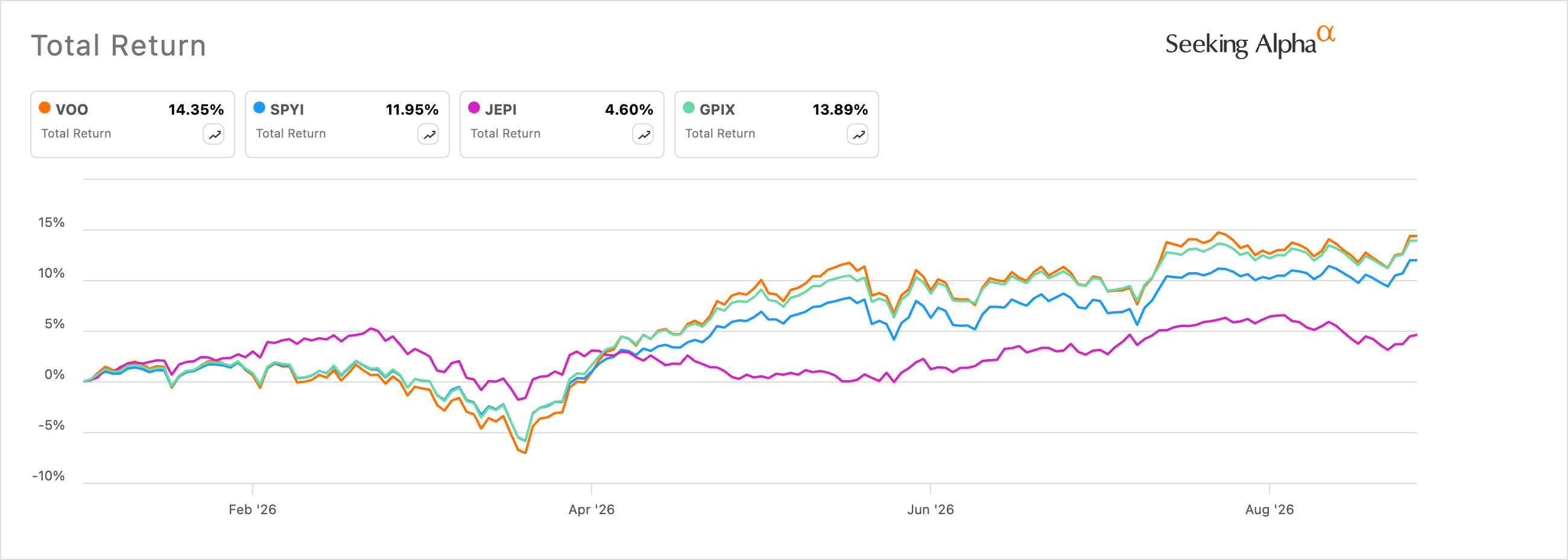
The chart above shows that the Vanguard S&P 500 (VOO) ETF has had over 14.35% in total returns this year. In contrast, the GPIX has gained 13.90%, while the SPYI and JEPI have risen by 11.95% and 4.60%.
The same performance is seen when looking at other timeframes. VOO has risen by 17.3%, while GPIX has jumped by 17.67%. JEPI and SPYI have risen by 8.18% and 16% in the same period.
These metrics suggest that, despite its low dividend yield, VOO is still a superior ETF than the boomer candy ones. The closest one in terms of performance is Goldman Sachs’ GPIX.